Talmudic Cognitive Behavioral Therapy with Orthodox Jews
Orthodox Judaism is marked by its staunch belief in the divine origin of the Hebrew Bible, or Torah, and its understanding of the Torah as supreme in the life of a Jew (A. Feldman, 2009; Kelemen, 1996). The Torah is not simply the recording of historical accounts and figures but the basis of authority and guidance in every aspect of life (Bergmann, 2021). In Jewish theology, the canon of the Torah includes the 24 books of the Pentateuch, Prophets, and Writings along with the Mishnah (elucidation of laws contained in the Torah), Talmud (further explanation and elaboration upon the Mishnah), Midrash (scriptural exegesis), Halacha (Jewish law), Kabbalah (mysticism), Machshava (Jewish thought), She’elos U’Teshuvos (Responsa), and medieval and contemporary rabbinic commentaries written throughout the millennia (Becher, 2010).
The Talmud, known as Shas (lit. Six Orders) or the Gemara (lit. study) and viewed as the central pillar of Jewish belief and practice, was compiled in the 5th century by Babylonian sages and contains 63 tractates across 2,711 folios (Becher, 2010; Kanarek, 2019). It provides insight into not only the interpretation of technical and practical law but also the requirements for leading a moral and virtuous life toned by Jewish values (Becher, 2010). In this respect, scattered across the pages of the Talmud are adages and proverbs guiding one to a fulfilling and ethical life (Steinsaltz, 1976). Replete with dialectical arguments, rigorous analysis, and anecdotes, the Talmud is as pertinent to today as it was when it was first compiled (Socken et al., 2009; Strack, 1945).
Judaism and Counseling
In Orthodox Judaism, which follows the Talmud, the human being is seen as more than the concomitant interplay of biology, sociology, and psychology; they are a spiritual being loyal to G-d and the Torah and toned by an unfailing commitment to Halacha, or Jewish law and practice (Abrams, 2023). This commitment extends so far as to render Halacha the domain of every dimension of daily life, essentially aligning and rendering the individual person as a Halakhic Man (Soloveitchik, 1984).
For Orthodox Jews, therefore, seeking improvement or change, spiritual transformation, or the relocation of the sacred and spiritual to the forefront often plays a significant role in life (Pargament, 2006). The relationship a Jew has to counseling, or the arena of help-seeking, is often embedded in sacred space or the converging realms of religion as ritual practice and spirituality as transcendental focus (Bohecker et al., 2017; Cashwell et al., 2007)). Utilizing a spiritual and religious framework when counseling Orthodox Jewish clients is recognized as clinically effective: for example, reading Talmudic passages reinforcing trust in G-d has been shown to reduce anxiety among counseling clients (Rosmarin et al., 2009).
Integration of Jewish Sacred Texts and Counseling
When applying such paradigms to Jewish communities and circles, it is critical to consider a further nuance. Given the centrality and value Jewish literature and texts hold in Jewish practice, the counseling process could be significantly strengthened by incorporating sacred texts, aptly reflecting the sacred space of counseling (Cashwell et al., 2007). As Judaism is at once spiritual and religious yet equally an all-encompassing way of life, the inclusion would not necessarily touch lightly upon this process, unless otherwise directed by the client, but could instead find direct and explicit integration (Lazar, 2020; Pargament, 2022).
Spirituality counseling, in this context, could utilize descriptions advanced by the Summit on Spirituality as a starting point, ultimately moving beyond its constructs of knowledge, growth, values, perspectives, and culture (ASERVIC, n.d.; Miller, 1999). The Summit on Spirituality was a series of ACA sponsored meetings held in 1995 that brought together counselor educators, practitioners, and scholars to articulate what eventually became nine foundational competencies for ethically and effectively addressing spiritual and religious issues in counseling (Miller, 1999). Integrating Jewish sacred texts in alignment with ASERVIC competencies into counseling interventions would serve as guides through which strength, hope, and compassion could be generated, and cognitive shifts and restructurings could transpire (Cook et al., 2011; Richards & Bergin, 2005). In this proposed framework, explicit integration, or the overt and direct use of sacred texts, might be preferred to implicit integration, as Jewish praxis heavily relies on and derives from textual analysis and interpretation, especially in Orthodox circles (Becher, 2010; L. H. Feldman, 1991; Milevsky & Eisenberg, 2012; Tan, 1996). While discussion and documentation of how Jewish sacred texts can be integrated into the counseling framework has been undertaken, the majority of scholarship covers integration from a Christian perspective, and further explication within the Jewish framework is recommended (Cashwell & Young, 2020; Kelemen, 2019; Rosmarin & Haimoff, 2019).
For counselors who are interested in implementing such an integrated approach to counseling, Cashwell and Young (2020) recommend beginning with the counseling intake form, from which a client’s level of religiosity, degree of interest in integration, and preferred type of integration (i.e., implicit or explicit) can be gauged. Such considerations are best addressed at the outset, as it empowers the client to decide whether such an approach should be taken (Richards & Bergin, 2005) and prevents the client from feeling pressured to overstate or understate their religious affiliation and interest in integration (Cashwell & Young, 2020).
Should the client opt for implicit integration, indirect references to Torah sources can be made (Richards & Bergin, 2005). Should explicit integration be preferred, citations from the Torah, Midrash, Talmud, or medieval or contemporary passages can be incorporated (Richards & Bergin, 2005). When aligned with specific therapeutic modalities such as cognitive behavioral therapy (CBT), such inclusion may have a cognitive restructuring effect on clients, as examining scriptural passages and examining one’s own thoughts are both activities that guide spiritual transformation: both shape how one views life (Propst, 1996). In this regard, utilizing a client’s own religious and spiritual framework to restructure cognitive distortions and processes benefits the client by preventing confrontation with the counselor: the scriptural text, supported by reflective exploration and dialogue, serves as a welcome external medium through which the client can reshape their thoughts, feelings, and behaviors (Griffith & Griffith, 2002; Grizzle, 1992). Cashwell and Young (2020) nevertheless caution against debating clients as to the meaning of texts, as such combative dialogue can rupture the therapeutic alliance and runs counter to the experience of sacred space (Cashwell et al., 2007). Should the counselor believe the client to be misreading or misapplying a text, consultation with colleagues of similar religious praxis to the client or a rabbi is advised (Cashwell & Young, 2020).
Judaism and Cognitive Behavioral Therapy
Today CBT, which is termed the gold standard of treatment (David et al., 2018), has been found to be an effective therapeutic modality for use with Jewish clients (Rosmarin et al., 2019). Several Jewish sources point to the notion that an individual’s thoughts and actions impact well-being, a basic principle of CBT (Shabtai et al., 2016). Additional alignments include the concept of choice and control over maladaptive thoughts and an active approach to character development and overcoming personal challenges (Shabtai et al., 2016).
These research findings are promising, as given the chief role and all-encompassing impact Jewish teachings have in Judaism, working with this client group in ways which are both evidence-based and congruent with their belief system can be implemented (Milevsky et al., 2011). Including religion and spirituality in the counseling framework is ideal for counselors (Myers & Sweeney, 2008). Orthodox Jews have often hesitated to seek mental health professionals who are not within their community out of concern that their practice will not align with their belief system or be adequately culturally responsive (Haimovich & Leiser, 2017). Instead, Jewish clients look for counselors who share their religious beliefs (Schnall, 2006) or at least can work competently within the Jewish framework, even if they come from a different faith or background (Rosmarin & Pirutinsky, 2020).
Integration of Jewish Sacred Texts and CBT
Given the supremacy of the Torah within Orthodox Jewish circles, it is important to properly understand the nature of faith integration when it comes to Judaism and CBT. Jacobson (2014) articulates, and then rejects, three models: a distinction between science/medicine and spirituality/religion, with the former being viewed with greater validity; the complete rejection of science/medicine and the embrace of spirituality/religion; and the integration and complementary nature of both. Jacobson prefers a model that does not view science/medicine on one side and spirituality/religion on the other but is cohesively grounded in divine unity. Though Jacobson’s paradigm reflects a specific sect and perspective of Judaic thought, namely, Chassidic philosophy, the notion of body and soul finding their unified placement within the human being is found across all strands of Jewish thought and literature (A. Feldman, 1990).
Within this framework, the focus is not intended to be the psychological but rather on Jewish thought (Turner, 2016). The exploration discussed by Jacobson (2014) must begin and rest upon a moral foundation (Turner, 2016), which in Jewish practice is Jewish literature. This is reflected in the approach Jews take to Torah study. Immense reverence is given to Torah sages and commentaries, such that a lack of understanding is deemed a deficiency on part of the one studying and not a lack of clarity on part of the commentary (Boyarin, 2021).
Given that spiritual and religious concepts develop from religious pedagogy (Harper et al., 2023) and shape core beliefs (Davis et al., 2011), it makes sense to utilize spirituality and religiosity as the central framework within a CBT-based model. To adopt CBT as the main focus, with Jewish teachings and sources as a supplementary framework, would imply that Judaism does not have all the answers (Strean, 1994) and point more to therapist drift than cultural competence (Waller & Turner, 2016). Even without cultural adaptation, CBT is as an efficacious treatment model for Jewish clients (Rosmarin et al., 2019); however, this does not mean that CBT as a solo and singular modality is the ideal means of working with this population. Rather, CBT adaptation is recommended (Nezu & Nezu, 2015), and an adaptation that puts Jewish texts and literature at the forefront is ideal. To propose and implement the reverse, such that Jewish concepts are woven into CBT, would place Judaism in an ancillary position and stand in contrast to a true Jewish viewpoint, which heralds the Torah as G-d’s word and Talmudic and similar Jewish texts as equally divine in origin (Talmud Bavli, Berachos 5a). The essential and core principles of CBT reflect concepts already documented in Jewish literature (Shabtai et al., 2016). Fitting Torah into a CBT-based model implicitly reverses this hierarchy that subordinates CBT to Jewish thought. One example is the codified teachings embedded in the writings of Maimonides (1135–1204), which predate modern CBT by nearly eight centuries (Shabtai et al., 2016).
Put another way, in an integrated model, the Torah serves as the epistemological or conceptual compass, setting the relevant values and perspectives to incorporate, whereas CBT provides the methodological or procedural map, steering the counselor–client directional process. In this vein, the Torah, which is of primary value and significance, is the centerpiece of the theoretical framework, and it is through the varied techniques of CBT that its relevant insight finds therapeutic intervention and application.
In practice, this means encouraging counselors to channel Jewish teachings, commentaries, metaphors, and stories through the evidence-based implementation of CBT (Schnall et al., 2016). This content can come from Judaism’s primary texts, such as the Hebrew Bible, Talmud, and Midrash, or from the more contemporary rabbinic literature, and be presented in ways that target cognitive reconstructing or other foci, as determined through the lens of CBT (Milevsky & Eisenberg, 2012). In this way, counselors can present concepts to their Jewish clients in ways that are value-congruent, relatable, and cast in meaningful and helpful language (Schnall et al., 2016).
This is the approach taken in the Handbook of Torah and Mental Health (Rosmarin & Haimoff, 2019), where the Torah source is cited first and psychological studies are explained subsequently. In this way, Rosmarin and Haimoff (2019) underscore the hierarchical placement and flow through which faith integration into CBT rightfully occurs. The Torah sets the stage for psychological research to lend insight.
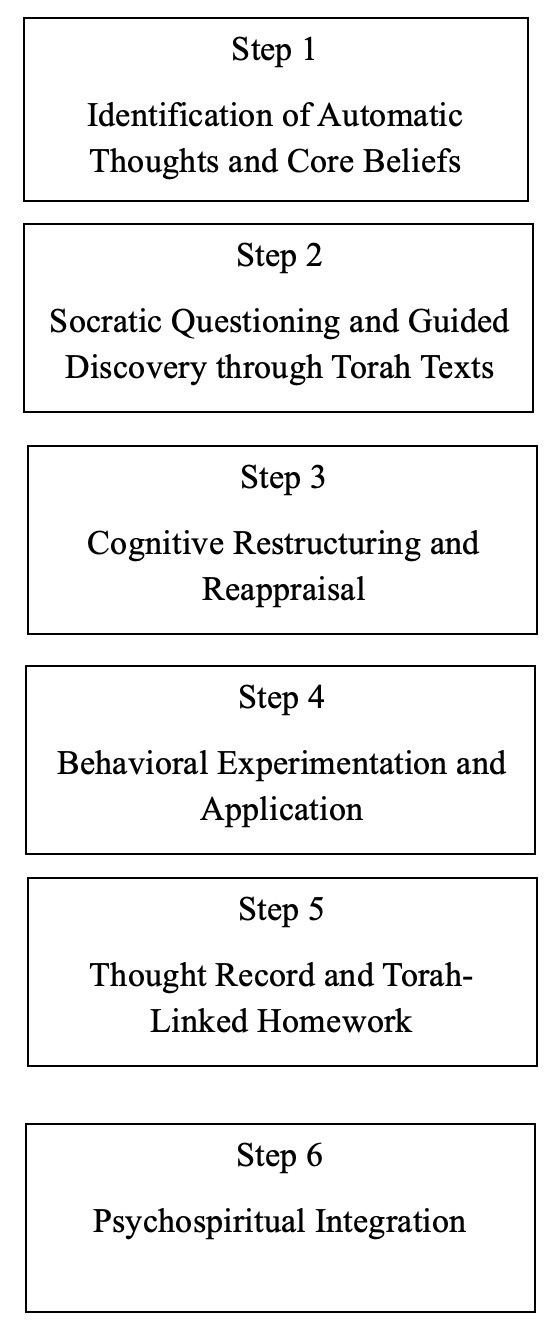
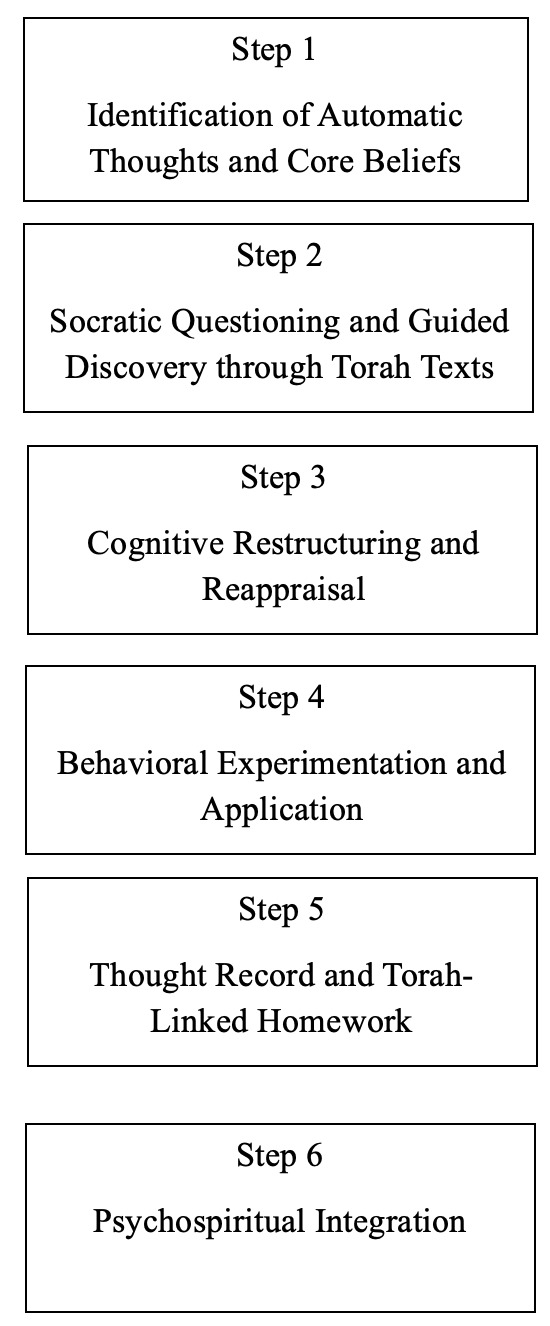
In a particular application of this integrated framework, the counselor and client move along a six-stage continuum. Step 1 entails the identification of the client’s automatic thoughts and core beliefs, which are often alluded to or stated on the intake form or during the initial session. Once these thoughts and beliefs have been determined, in Step 2, the counselor facilitates the client’s critical examination of them via guided discovery and specifically a series of Socratic questions, which indirectly prod the client to survey old patterns of thought and consider new angles (Padesky, 1993). The unique value of an integrated therapeutic model is the unfolding of this guided discovery through engagement with Torah and Talmudic sources. This dynamic carries undertones of the classic chavrusa, or partner-based, learning model that Jews across the Orthodox spectrum use to study of sacred texts (Holzer & Kent, 2013). At the forefront of this mode of learning engagement are three processes that can be carried over to the counselor–client relationship: the textual-interpretive process, which refers to the client’s reading and processing of the text, as facilitated by the counselor; the intrapersonal process, or the client’s growing awareness of their own preconceived and/or newly developing beliefs and perspectives; and the interpersonal process, or the mutual attunement that develops between a counselor and a client (Holzer & Kent, 2013).
Step 3 captures the cognitive restructuring and reappraisal process by which the Jewish texts reorient and reconfigure the client’s old views to Torah-congruent alternatives. Step 4 offers the opportunity for clients to engage in behavioral experimentation outside of and beyond the counselor–client physical space and viscerally experience the application of their newly shaped perspectives. Step 5, extending the preceding stage, furthers the cognitive and emotive layers of reappraisal by guiding clients to document their thought patterns and processes utilizing the classic thought record advanced in CBT (Ryum & Kazantzis, 2024) and supplement the record with adjacent Torah verses or passages that lend new insight and serve as vehicles of transformative cognitive restructuring. Step 6, ensuing both in the form of direct counselor–client dialogue and as a summative and reflective overall process, points to psychospiritual integration, whereby the client’s newly developed perspectives reflect both spiritual grounding and psychological growth (Figure 1).
A final factor influencing this integrative process is the counselor’s pre-selection, after reviewing the client’s history and intake information and anticipating thematic fit, of two to five relevant Torah sources that are readily available to be used in session. This selection is only preliminary, as in-session and client-centered flexibility takes precedence. In line with CBT processes and principles that emphasize guided discovery (Padesky, 1993), the integration of Torah sources should balance structure with flexibility and drive active counselor–client teamwork (Kazantzis et al., 2017).
Talmudic Cognitive Behavioral Therapy
Although Jews are a minority population (Haanshuus, 2024) and are relatively absent from the professional counseling literature (Altman et al., 2010), a small yet developing area of research focuses on how Jewish stories, teachings, and prayers fit into Jewish clients’ treatment (Schnall et al., 2016). However, aside from the work of Rosmarin and Haimoff (2019), described by Kelemen (2019) as groundbreaking, there is no comprehensive compendium of relevant and applicable Jewish literature and texts to use in the delivery of mental health services (Schnall et al., 2016). Although over 50 clinical trials have examined the dynamics of spiritually integrated therapy (Rosmarin et al., 2010), these studies have predominantly focused on Christian theology (Shabtai et al., 2016) or are limited in other ways. Kaplan and Schwartz (2004), for example, have collected 58 Jewish narratives to be used in the practice of psychotherapy, but their focus is strictly on the Hebrew Bible and does not extend to other Jewish literature. Moreover, Levitz and Twerski’s (2005) A Practical Guide to Rabbinic Counseling, which follows a textbook model and includes religious content curated for counseling the Jewish community, omits theological excerpts in the interest of providing clinical information and sage advice (Friedman, 2010).
Indeed, a wide-ranging mapping of Torah passages, concepts, axioms, and parables to be used in Orthodox Jewish circles, and which includes the Talmud, Midrash, Halacha, Machshava, Chassidus, and contemporary rabbinic writings, has yet to be undertaken. Exploring these sources and explicating how their content applies to presenting issues seen among Jewish clients is an area in need of significant research. Such an endeavor and framework, which could be termed Talmudic CBT (T-CBT), would be of benefit to the larger Jewish community (Schnall et al., 2016) and has already been documented as empirically efficacious in clinical settings (Rosmarin et al., 2010), justifying the operationalization of these principles for clinical significance. Shabtai et al. (2016) argues that such principles could be powerful tools to use in the treatment of Jews and non-Jews alike. The literature suggests clients are in favor of this method, with findings indicating that clients mention how concepts discussed by their counselors are located in Jewish sources (Golker & Cioffi, 2021).
In one described case, Pies (2024) captures how a counselor assists his client in gaining better control over his temper by asking him to imagine the person he is angry with as if they were a baby in their mother’s arms. This notion, notes Pies (2024), derives from the writings of Rabbi Moshe Cordevero (1522–1570) in his work Tomer Devorah (1:30). In the context of rational-emotive behavior therapy (REBT), Schiffman (2016) profiles a client grappling with anger and cites numerous Talmudic and contemporary sources that align with REBT in shaping the focus of intervention. While Pies (2024) and Schiffman (2016) have laid the groundwork for how a counselor–client dialogue might unfold when using primary Jewish texts, and Rosmarin and Haimoff (2019) have compiled a number of Torah resources aligning with CBT, dialectical behavioral therapy (DBT), general psychotherapy, and a number of other clinical issues, Kelemen (2019) encourages the expansion of these concepts.
Case Example
This paper offers a case example expanding upon this integrated framework. The example includes a verbatim Hebrew text translated into English by the author. In order to best demonstrate the process for implementing this framework, the paper presents a step-by-step dialogical sequence between counselor and client, inclusive of counselor reframing skills and client cognitive reflections.
A 38-year-old Orthodox Jewish man and 37-year-old Orthodox Jewish woman sought counseling after receiving news from their family doctor that, despite their latest series of fertility treatments, there did not appear to be hope for them to conceive. The man and woman reported to counseling, where they detailed their history.
They had been married for 16 years, having gotten married young, and they had attempted to start a family many times with no success. Despite multiple tests and treatments, they were unable to conceive and stopped their fertility treatments. To their surprise, two years after this stoppage, the wife suddenly conceived.
Three weeks after the child’s birth, however, the child began showing signs of heart failure. Although the doctors had disclosed to the parents during pregnancy that there was a small possibility of the condition occurring, the severity of the newborn’s condition was unexpected even by the medical staff. The onset of this news caused the parents intense anxiety, as they remained uncertain of their child’s future. Unfortunately, it was not long before the child’s heart condition rapidly declined, and one night, the child passed away in their sleep. At the news of this, the parents were devastated.
It took two years for the parents to fully recuperate from the loss, at which point they began to try for another child. Again, they were unsuccessful. At ages 38 and 37, they presented for counseling at the referral of their family rabbi with a new consideration weighing on them: adoption.
Prior to the first session, the counselor requested that the couple complete an intake form. Using this intake form, the counselor gathered background information from both husband and wife and gauged their level of religiosity, interest in integrating Torah sources into the counseling process, and preferred type of integration (e.g., implicit or explicit). The husband and wife responded by indicating their Orthodox affiliation, desire to integrate Torah sources into the counseling process, and preference for explicit integration. Both husband and wife likewise indicated on the intake form their hesitation about adoption: although they viewed adopting a child as a noble act, they did not see it as equal to conceiving on their own. Armed with this knowledge and in collaboration with an Orthodox Jewish colleague, the counselor prepared and reviewed an array of sources relating to adoption, including the Torah, Talmud, Midrash, Code of Jewish Law, and medieval and contemporary commentaries.
At the start of the first session, the wife expanded upon what she had documented on the intake form. “It’s not my child,” she said. “I really want it to be mine, not someone else’s. Do you know what I mean?” The counselor reflected the wife’s sentiment, underlining how her desire for motherhood is such that it stems completely from her and her husband. “I mean, maybe I’d feel differently if I saw things another way, but I just don’t right now.” The husband concurred.
Attending to the wife’s comments about childrearing, the counselor asked whether the couple would be open to examining some Jewish sources about adoption and seeing what they discovered together. They both said that they would like that. Using a collaborative tone and remaining mindful of the CBT emphasis on psychoeducation and cognitive restructuring and reframing (Tan & Johnson, 2005), the counselor handed both husband and wife a paper with several Torah sources on it. The sources were printed in both Hebrew and English.
The counselor asked whether the husband or wife wished to read the first source from the Talmud Bavli, Sanhedrin 19b. The husband agreed to do so.
According to R’ Yehoshua ben Korcha, isn’t it written, “And the five sons of Michal, the daughter of Saul” (II Samuel 21:8). R’ Yehoshua would say to you: And did Michal give birth to these children? But didn’t Meirav give birth to them? Rather Meirav gave birth to them, and Michal raised them. Therefore, they were called by her name, to teach you that anyone who raises an orphan in his house is considered as if he gave birth to him.
The counselor inquired of the husband and wife what this passage meant to them. The wife was intrigued to learn of this and said that, upon reflection, perhaps there was more to adoption than she had considered. “Is this meant literally?” she asked. The counselor looked to the husband, seeking to include him in the conversation. He said he was unsure whether the passage was meant literally. The counselor, seeking to draw out the couple’s core beliefs related to bearing a child themselves v. adoption, turned to Socratic questioning. “What would it mean to you if it was not meant literally?” asked the counselor. “It might even be worse,” said the wife, “because then having an adopted child may always remind me of the fact that I don’t have an actual child that I gave birth to on my own.” The counselor inquired further. “And what effect would that have on you?” “It would make me feel as if I am not living up to my role as a Jewish woman,” the wife replied. “And why would that be the case?” prodded the counselor, in line with the tenets of Socratic dialogue. “Because as a Jewish woman, a huge part of my role and responsibility is to raise a family.” The counselor looked to the husband, who confirmed that he understood what his wife was saying and could appreciate where she was coming from as an Orthodox Jewish woman living in an Orthodox community.
Having identified some of the underlying core beliefs, the counselor mentioned that another source appeared to address this matter of literalism. It was a citation from Rabbi Shlomo Kluger, in his commentary on the Code of Jewish Law (Chochmas Shlomo, Even Ha’Ezer 1:1):
I was doubtful regarding one who raises a boy or girl orphan in his home, if this is considered as if he has fulfilled the commandment to be fruitful and multiply. Since our Sages say that anyone who raises an orphan in his home, it is considered “as if” he gave birth to them, it can be said that this is also as if he fulfilled the commandment to be fruitful and multiply. Or perhaps, it is not literally comparable to giving birth and he has not fulfilled the commandment. It would appear that this is dependent upon a dispute between the Derisha [Rabbi Yehoshua Ha’Kohen Falk; 1555–1614] and the Taz [Rabbi Dovid Ha’Levi Segal; 1586–1667] in Yoreh De’ah (Section 242). The opinion of the Derisha is that anytime it is stated “as if,” it means that the matter being compared is not equal to what it is compared to. But the Taz argues and says that it is literally comparable. Therefore, according to the Derisha, since it is not a literal comparison, when it says “as if,” it does not mean so literally and he does not fulfill the commandment to be fruitful and multiply. But according to the Taz that it is literally comparable, he does fulfill the commandment to be fruitful and multiply. However, even according to the Derisha, this is only if he never gave birth at all; however, if he gave birth and the children died, and he then raises an orphan, he certainly fulfills the command to be fruitful and multiply. This is the case because either way he fulfilled the command to be fruitful and multiply. If the command is that he must give birth, he literally gave birth; and if the command is to raise a child, he is raising an orphan. And though it is true that he did not give birth to the orphan, he is nevertheless raising him, and with that, he fulfills the command. This is what appears to be correct to me in accordance with the law.
The husband and wife expressed both surprise and relief to be presented with this information. Cognizant that according to CBT, the interpretation of an event, rather than the event itself, is what generates emotions (Beck, 1979), the counselor asked whether the meaning of these passages from the Talmud and the commentary of Rabbi Shlomo Kluger had any personal implications for the couple. The wife asked whether all of the above would remain true even if the child was not an actual orphan but had rather been given up because their parents could not care for them.
The counselor pointed to a third source and asked whether the wife wished to read it. It was a statement from Rabbi Yaakov Emden (1697–1776) in his Responsa She’elas Yaavetz (1:165):
This is not only true [that one who raises an orphan is as if he gave birth to him] with an actual orphan. Rather, even if he has a father and mother, and he is raised by another for the sake of a mitzvah (good deed), this is true.
“But what about the birth parents?” asked the husband. “Are they not considered the child’s parents?” The counselor referred the couple to a fourth source, from the Midrash Rabbah (Shemos Rabbah 46:5):
A parable of a young girl, orphaned from her parents, who was raised by a legal guardian. He was a good and trustworthy man who raised her and protected her. Eventually, he wished to marry her off. When the scribe arrived to write the marriage contract, he asked her, “What is your name?” She replied, “My name is so-and-so.” “And what is the name of your father?” She began to grow quiet. The guardian asked her, “Why are you being quiet?” She replied, “Because I do not know of another father other than you, for one who raised another is called their father, and not the one who gives birth.”
After reading this, the wife inquired further of the counselor: “Why is the one who gives birth to the child not called their father?” The counselor pointed to the commentary Etz Yosef (Shemos Rabbah 46:8–9), which elaborates:
She was quiet and did not say the name of her [biological] father out of honor for her legal guardian, since he is called more of her father . . . when the one who gave birth to the child does not raise the child.
“To address your question,” said the counselor, “it seems from this comment of the Etz Yosef that the biological father is also her father, but the one who raises the child is considered more so.” At this point, the counselor checked in again with both husband and wife, asking what these developing ideas meant to them. The husband spoke first.
“It seems that raising an orphan is a very laudable thing to do, and G-d considers it as if we gave birth to the child ourselves. Moreover, the fact that we had a child and unfortunately lost him, were we to adopt another child, it would be considered as if we gave birth to the child, according to all opinions. It would be doing everything we possibly could.”
The wife then added her own view. “I never thought of it this way. For two years, I was so consumed by the loss of our first child that I couldn’t imagine adoption. But now, I think it might be something I’d want to think about. If the child we adopt is considered our own child, what more can we do now if G-d has not blessed us with the ability to conceive on our own?”
The husband and wife indicated that they would like to discuss this matter further. At the moment, however, they agreed that reviewing these Torah sources had given them both a newfound perspective, significantly lifted their spirits, and had given them hope.
The counselor concluded the session by asking whether they would like to try a behavioral experiment that would test their developing perspectives. They concurred. The husband and wife collaboratively decided to review together the aforementioned Torah and Talmudic sources on Friday night and attend synagogue the following day, where it was common for husbands, wives, and children to congregate. There, they would deliberately pay attention to the children, mindfully observing whether such exposure triggered emotions of frustration, sadness, yearning, or otherwise, all the while bearing in mind the concepts they had reviewed the night before. After the Sabbath, they would construct a thought record documenting their experience and whether, and if so how, their perspectives had been impacted by the Jewish sources.
Discussion and Implications
This example illustrates how integrating Jewish literature into CBT can be an effective modality when working with Orthodox Jewish clients (Rosmarin et al., 2019). By utilizing culturally relevant texts and teachings, professional counselors can facilitate cognitive restructuring and provide clients with new perspectives (Richards & Bergin, 2005). This approach underscores the importance of cultural competence and the need for therapeutic models that resonate with clients’ deeply held beliefs and values (Rosmarin & Pirutinsky, 2020).
The integration of Jewish literature into CBT has significant implications for the counseling profession. First, it highlights the necessity of cultural adaptation in therapeutic practice (Nezu & Nezu, 2015). Orthodox Jewish clients, like many other cultural minority groups, may be hesitant to seek mental health services that do not align with their belief system (Haimovich & Leiser, 2017). By incorporating Jewish ideas and values into counseling, counselors can bridge this gap and provide a more welcoming and effective service. This approach can likewise enhance the therapeutic alliance, as clients are likely to feel understood and respected when their cultural and religious values are acknowledged and integrated into treatment (Schnall, 2006). This can lead to higher levels of client satisfaction and better treatment outcomes (Rosmarin & Pirutinsky, 2020).
Challenges to the implementation of this integrated framework include the lack of a compendium of Torah sources across counseling themes; the need for counselors who have been trained to utilize CBT as the dominant paradigm to competently expand their repertoire to include Torah knowledge; the imperative of maintaining fidelity and rigor in the distillation and application of both Torah concepts and CBT principles; differences in religious praxis and philosophy across the Orthodox spectrum and the dexterity needed to make use of explicit textual integration in ways that honor variability across such orientations; time constraints within sessions; and linguistic barriers to understanding and interpreting original texts in Hebrew or Aramaic.
To support counselors when challenges in the integration of Jewish literature into CBT arise and aid in the future of counselor education, a published, comprehensive compendium of Torah sources and a standardized counselor education curriculum that includes training in the integration of client faith into counseling sessions are required (Briggs & Rayle, 2005). Counselor-education programs should incorporate modules on cultural competence across multiple curricular areas, with a specific focus on working with different faith groups, including the Jewish population. Counselors should also work to understand the supreme position of Torah, the significance of the Talmud, and the practical application of Jewish teachings to issues discussed in counseling. Additionally, training programs should emphasize the importance of collaboration with religious leaders and the use of sacred texts in counseling as a form of rabbinic–clinical consultation (Holliman & Wagner, 2015). This could be achieved through partnerships with Jewish institutions and collaboration with rabbis (Holliman & Wagner, 2015). Ongoing clinical supervision would likewise buffer issues that arise in the balance and blend of the Torah and CBT in concert with Torah principles and evidence-based practice.
Conclusion
While the integration of Jewish literature into CBT shows promise, further research is needed to empirically validate this approach. Future studies might explore the efficacy of this model in various clinical settings and with different presenting issues. Additionally, research should examine the long-term outcomes of clients who receive this integrated therapy compared to the outcomes of those who receive standard CBT. Developing a comprehensive compendium of Jewish texts relevant to mental health counseling, as suggested by Kelemen (2019) and started by Rosmarin and Haimoff (2019), would also be valuable for practitioners. Such a compendium would provide counselors with a readily accessible toolkit of Jewish teachings that could be used to address a wide range of psychological issues. In line with best practices for this population, counselors should attend to the unique context of Jewish life and make use of the clients’ most central identifier, namely, Jewish literature. With both these measures in place, clinical outcomes are likely to reflect high rates of treatment efficacy and client satisfaction.
Disclosures and Acknowledgments
The author(s) declared no potential conflicts of interest with respect to the research, authorship, and publication of this article.
The author(s) reported no financial support for the research, authorship, and publication of this article.
All views and opinions expressed within the published articles are those of the author(s) and do not represent the views and/or opinions of The Journal of Faith Integration in Counseling or the Editors. Published articles and all information within the publication are solely the responsibility of the author(s) of the article.
The author(s) retain the copyright to this article and have agreed to publish and distribute this article in the Journal of Faith Integration in Counseling.
This article is licensed under a Creative Commons Attribution-NonCommercial-Share Alike 4.0 International License